PrimerTeach-Back Engine
What it does for you
Turns the sprint's case studies into a course with skill modules, exercises, self-check quizzes, a landing page with real proof numbers, and a printable syllabus, all regenerated from the project files.
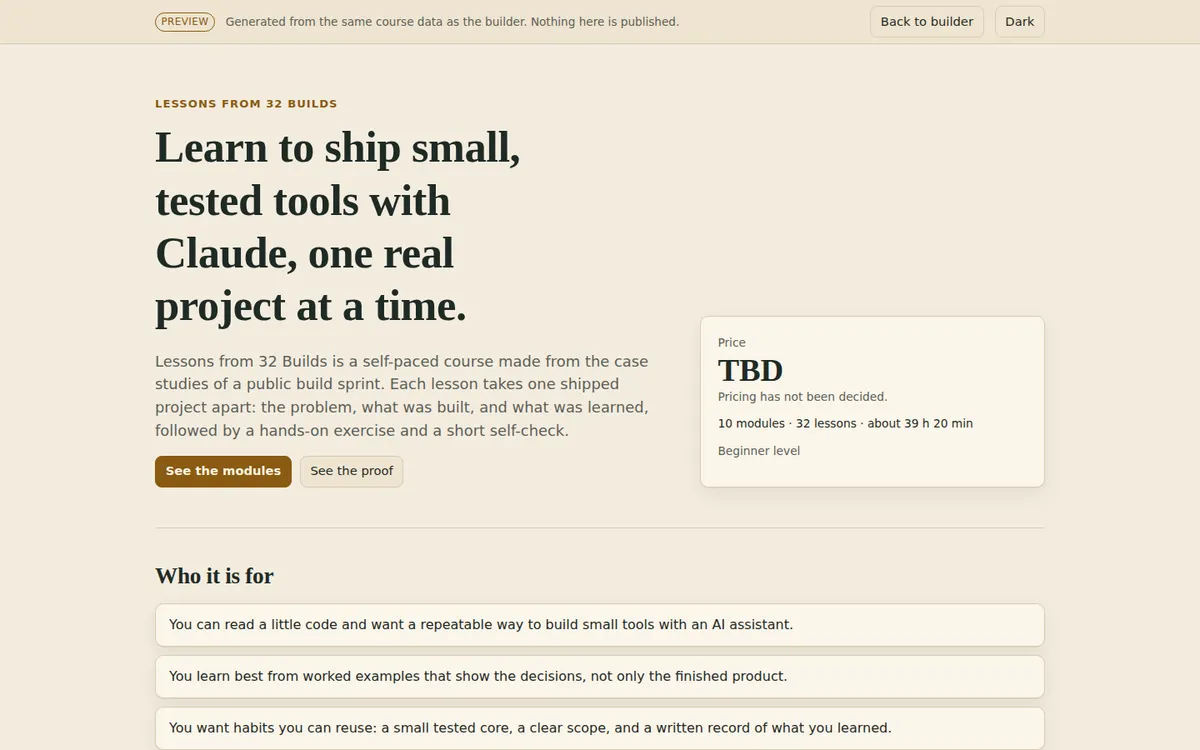
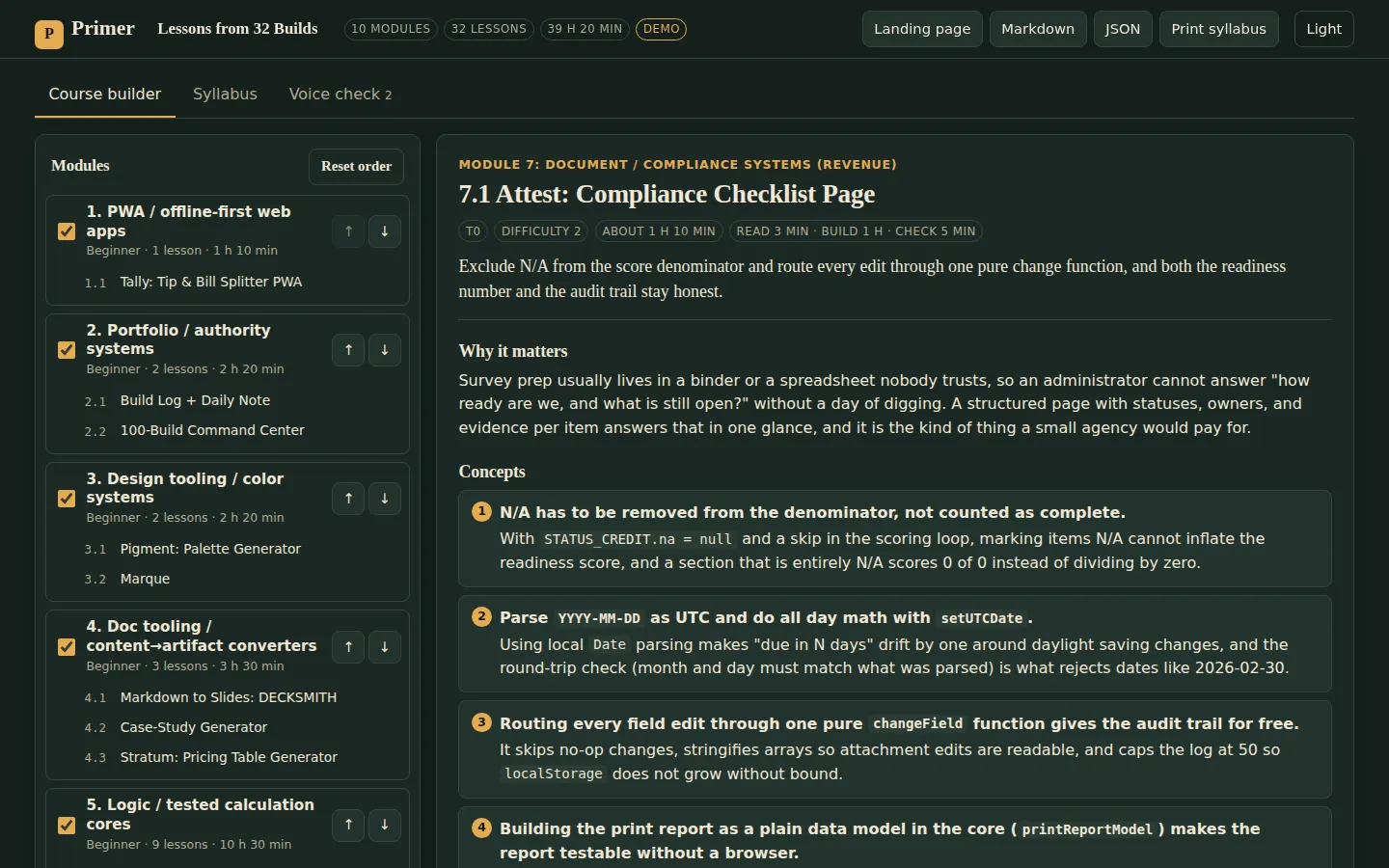
Screenshots
In more detail
Primer turns the case studies from this sprint into a course: lessons, exercises, quizzes, a landing page and a printable syllabus, all generated from the project files. A folder of write-ups is not something another person can learn from in order. Primer puts them in order.
Honest limits
The Claude API was never called during the build; the polish mode needs my own key. The demo uses a frozen snapshot of 32 case studies, not all 100. The price is TBD on purpose, and the landing page is a preview, not a live offer. The pages were checked with screenshots of the builder, landing page, syllabus and mobile layout, not by someone working through a full lesson.
How I built it
This was one of the Claude Cowork one-shots. I told Cowork to one-shot all the Cowork projects. For Primer it read the project list, the case-study template, the skill matrix, the tracker and the 32 case studies that were filled in at the time, then specced it inside the T3 box. About 0.8 hours. That Cowork session dropped all 20 of its finished builds into the repo within about a minute and merged them into the tracker itself.
Cowork wrote a corpus builder that parses every case study, the skill matrix and the tracker into one JSON file. A pure core, course.js, groups projects into skill modules ordered beginner to hard, with one lesson per project: concepts from "What I learned", why it matters, the project as a worked example, an exercise, a three-question fill-in-the-blank quiz and a time estimate. The same course.js runs in the builder, both pages and the tests. Around it: a course builder page, a landing page preview with the price marked TBD, exports, a voice lint and a sample syllabus PDF.
What I learned
- Normalize source text at the parser, not at render time. Older case studies use em dashes, so paired dashes become parentheses, single ones semicolons, and title dashes colons on the way in. Every export stays dash-free without touching the originals.
- Grouping by skill needs a ranked rule, not a lookup. Evidence citations beat list membership, which beats keyword matches. The smaller, more specific row wins ties, and broad rows like "1 to 31 (most)" are ignored.
- Quiz blanks work best on code terms, but only after capping them at 30 characters. Long expressions with slashes made nonsense wrong answers.
- A fact guard for AI rewrites can be strict and cheap. Any number,
#Nreference, other project name or code identifier not already in the source lesson rejects the rewrite. In a mocked test, a rewrite claiming "37 percent faster audits, like Tincture" failed on both counts.
What carried forward
Primer is the teach-back piece of the original plan: every project produces a case study, and those case studies become the portfolio (#96), the documentary (#99) and this. It also connects to what I want to do next with this sprint: turn it into content, working knowledge and a Substack. Primer is a first draft of how that material could be organized.
If I took it further
I would let one project feed more than one module when the skill matrix cites it twice, showing the lesson once and cross-linking it. I would also add a per-lesson include switch and a short editor note, so I can drop a weak lesson or add context without touching the case study.
#100 Built with Claude Cowork September 23, 2026 262 automated checks