HelmAI Ops Command Center
What it does for you
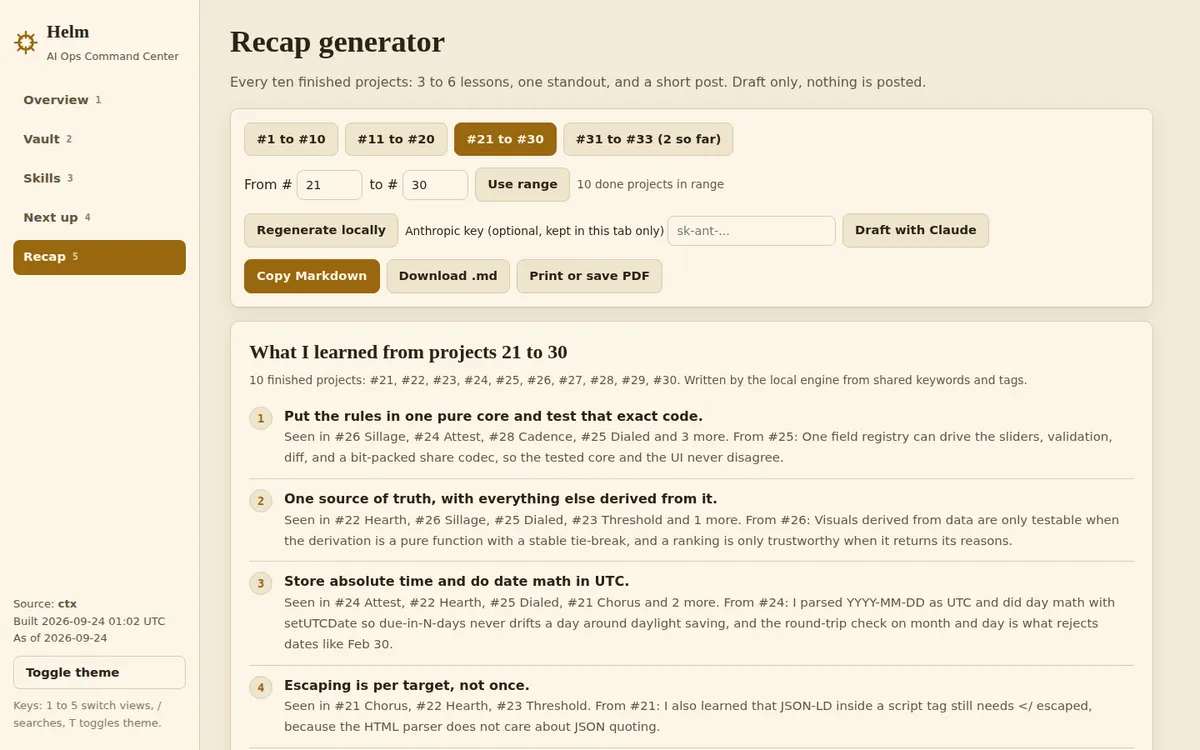
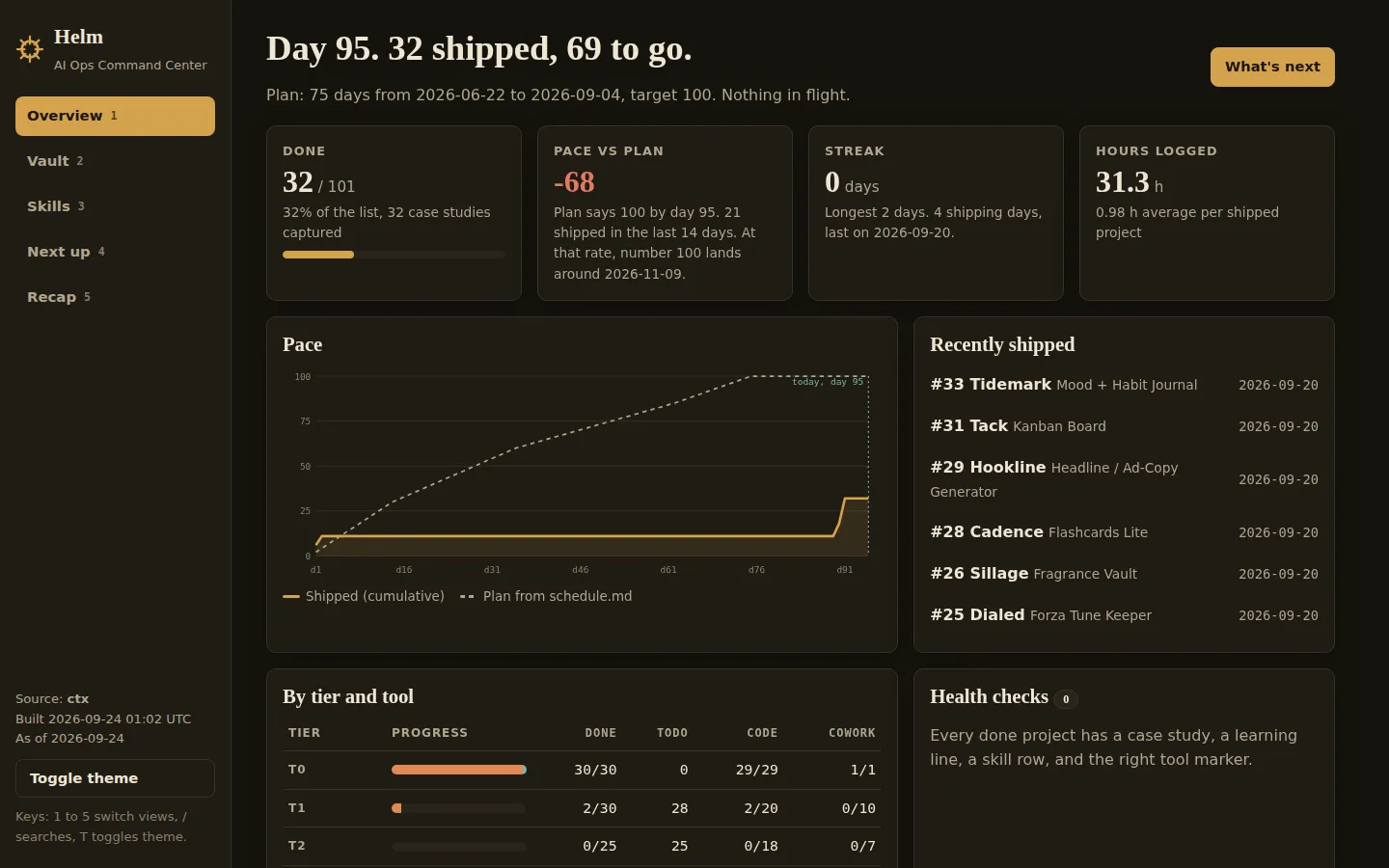
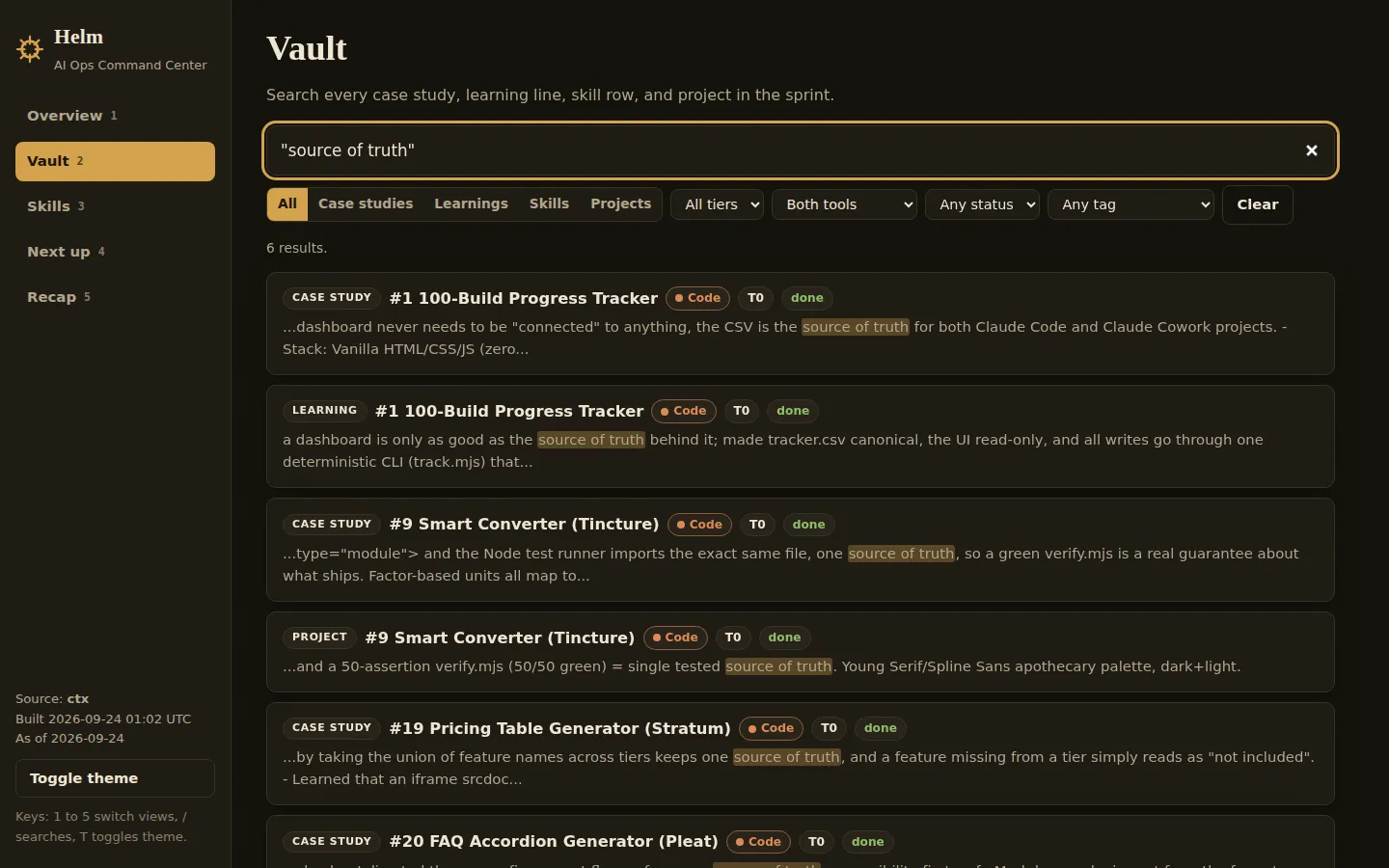
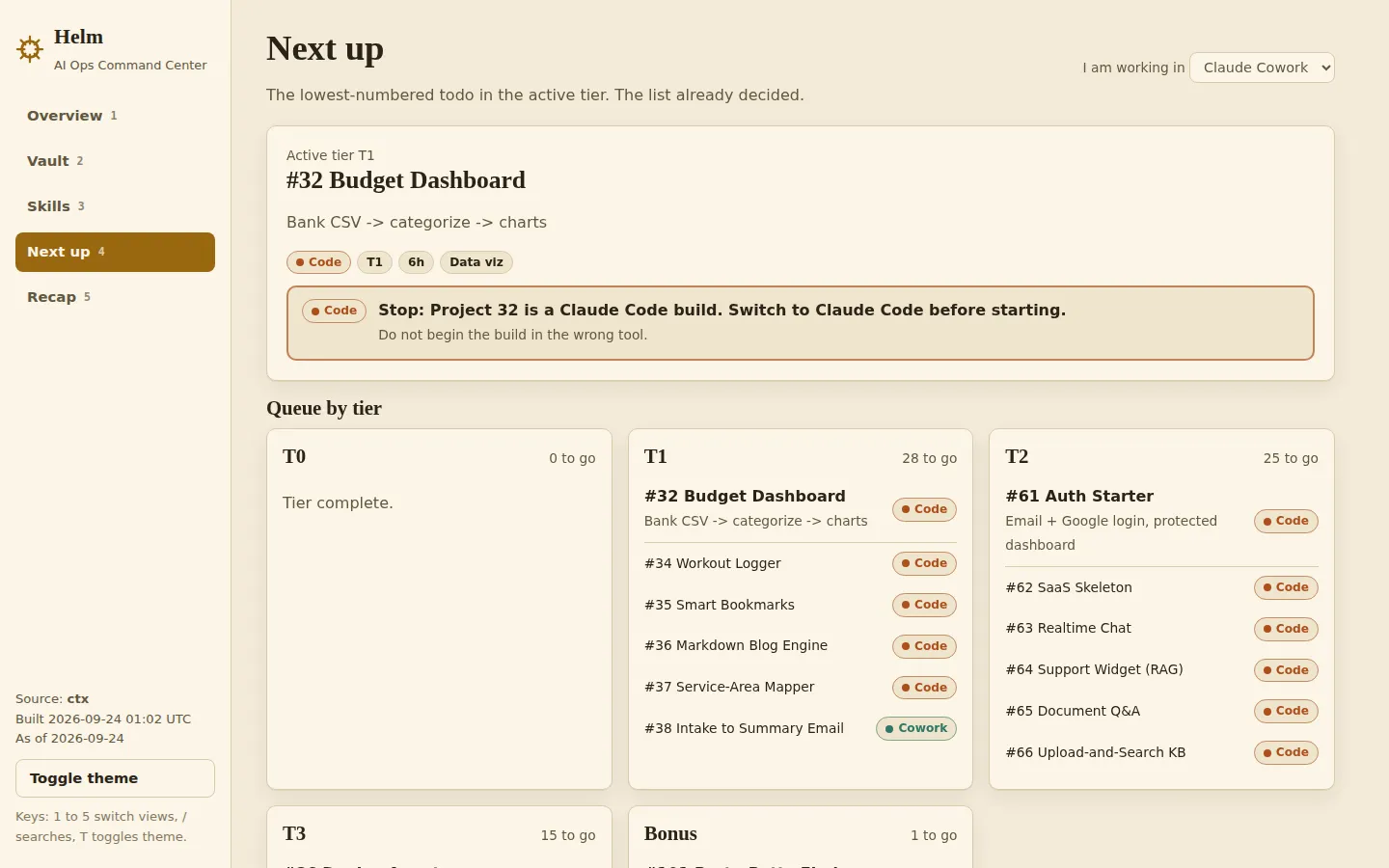
An operator console over the whole 100-build sprint: pace against plan, a searchable vault of every case study and lesson, a next-up queue with the tool guard, and a recap generator that drafts lessons, a standout, and a post.
Screenshots
In more detail
Helm reads my whole 100-build sprint folder and turns it into one console. It shows how I am pacing against the plan, what to build next and in which tool, a searchable vault of every case study and lesson, and a one-click draft of the recap I owe every ten projects.
Honest limits
The live Claude call was never exercised, because the sandbox blocked outbound API traffic. The prompt builder and parser are covered by fixtures only. The screenshots show the real September 23 snapshot, when 32 projects were done, so the numbers in them are already out of date. It runs and the 238 checks pass, but it was one-shot, not tuned over weeks of real use.
How I built it
This was a Claude Cowork build. I told Cowork to one-shot all the Cowork projects, and for this one it read the brief, the sprint's system files and project 24 as the gold-standard example, then specced, built, tested, screenshotted and documented Helm in one pass. About 0.6 hours. Setting up a Cowork build honestly felt faster than setting up a Claude Code build; I handed it the folder and the rules and it went.
There is a builder script that parses the real folder into one vault file, and a page with five views over it. One pure function, buildVault(files), takes raw file text and returns the whole vault, so the builder, the demo and the tests all go through the same code. The next-up view enforces the tool guard, and a Cowork skill file runs the same workflow with draft-only connectors. It checked its own screenshots and fixed what it found, including a mobile overflow and a blank trailing PDF page.
What I learned
- 69 of the 101 project folders already had a
case-study.mdthat was still the unfilled template. So "has a case study" has to mean "is not the template," and Helm treats a placeholder number or empty sections as a stub. - Old source files use em dashes as structure, like between a project name and its lesson. Helm parses with them first and cleans them out of the finished vault after, and a test greps every shipped file, including the generated
vault.json. - Greedy set cover alone gave only three lessons per block, because the "tested core" theme covers nearly every project. Letting broad themes through at 30 percent coverage gave 4 to 6 real lessons.
- Every recap draft, local or Claude, passes one validator. That is how "cite only projects in this range" and "no em dashes" are enforced instead of hoped for.
What carried forward
Helm is built entirely on the folder structure I set up before project 1: tracker.csv as the scoreboard, a case study per folder, the learnings log, the skill matrix, the schedule and the tool markers. It also reads the LOG-ENTRY files Claude Code and Codex used to hand work back. It is one of five builds in this range (with #96, #98, #99 and #100) that read the sprint's own records, and its recap generator serves the ten-project recap rhythm in the plan.
If I took it further
I would have the builder write the drafted recap into a pending section of the learnings log behind an explicit flag. I would also put the vault search and range in the URL so a view can be shared as a link.
#097 Built with Claude Cowork September 23, 2026 238 automated checks